
Plymouth County City Directory Collections
The historical record is spread among several keepers. The 1867 Plymouth County directory is a Stillman B. Pratt & Co. volume, while the digitized 1909 Plymouth resident and business directory is identified as the sixth volume from Boston Suburban Book Co. The Massachusetts State Library holdings list supplies the most useful year-by-year check for Plymouth runs. It also shows why a family trail may skip years without proving that the family vanished. A volume can cover only a town, a commercial district, or several neighboring towns.
| Collection | Years | Where held | Access |
|---|---|---|---|
| Plymouth County directory and historical register, Stillman B. Pratt & Co. | 1867 | State Library holdings and archival catalog references | Catalog and reading-room research |
| Plymouth resident and business directory, Boston Suburban Book Co. | 1909, sixth volume | Internet Archive | Free image and text downloads |
| Plymouth city directories | 1887-1888 through 1990, with gaps | Massachusetts State Library | Collection status varies by listed volume |
| Historic Houses Collection | 1992-1995 survey | Plymouth Public Library Bartlett Room | Ten locality binders and street index |
| Plymouth Sanborn fire-insurance maps | March 1891 | Library of Congress | Public-domain, nine-sheet set |
For Carver, Halifax, Hanson, Plympton, Pembroke, and Duxbury, documented commercial directories include multi-town examples from the early twentieth century. Search the town name as well as Plymouth County. The collection record, not an assumed annual schedule, decides what was published and what survives. Note: An absent year often signals a gap in the shelf, not a gap in a household's history.
Plymouth County Directory Milestones
The known sequence has useful anchors. The 1867 county directory gives an early named, occupational, and residence-location view. The 1909 volume adds a resident and business design at a moment when Plymouth was represented as the sixth volume in its series. State Library listings then document Plymouth runs for 1887-1888, 1890, 1893, 1896, 1898-1901, 1903, 1905, 1907, 1909, 1917, 1918-1924, and a scattered group of later volumes through 1990. Asterisks in that State Library list mark holdings whose format or handling needs the library's local key.
- 1867: Stillman B. Pratt & Co. issues the verified Plymouth County directory.
- 1887-1990: the State Library records uneven Plymouth runs, including clusters and isolated later years.
- 1909: Boston Suburban Book Co.'s resident and business directory appears as a sixth volume and is digitized.
- 1992-1995: the Massachusetts Historical Commission survey creates the ten-binder Historic Houses Collection.
The digitized 1909 Plymouth directory is a practical first stop when the date fits. Its catalog supplies the publisher, place, language, and download choices, but an online scan does not erase the value of the physical holdings. Later searches may need a reading room because neighboring-town runs and reverse sections are not guaranteed in every digital copy.
The captured Internet Archive record for the 1909 directory identifies the digitized volume before a search begins.
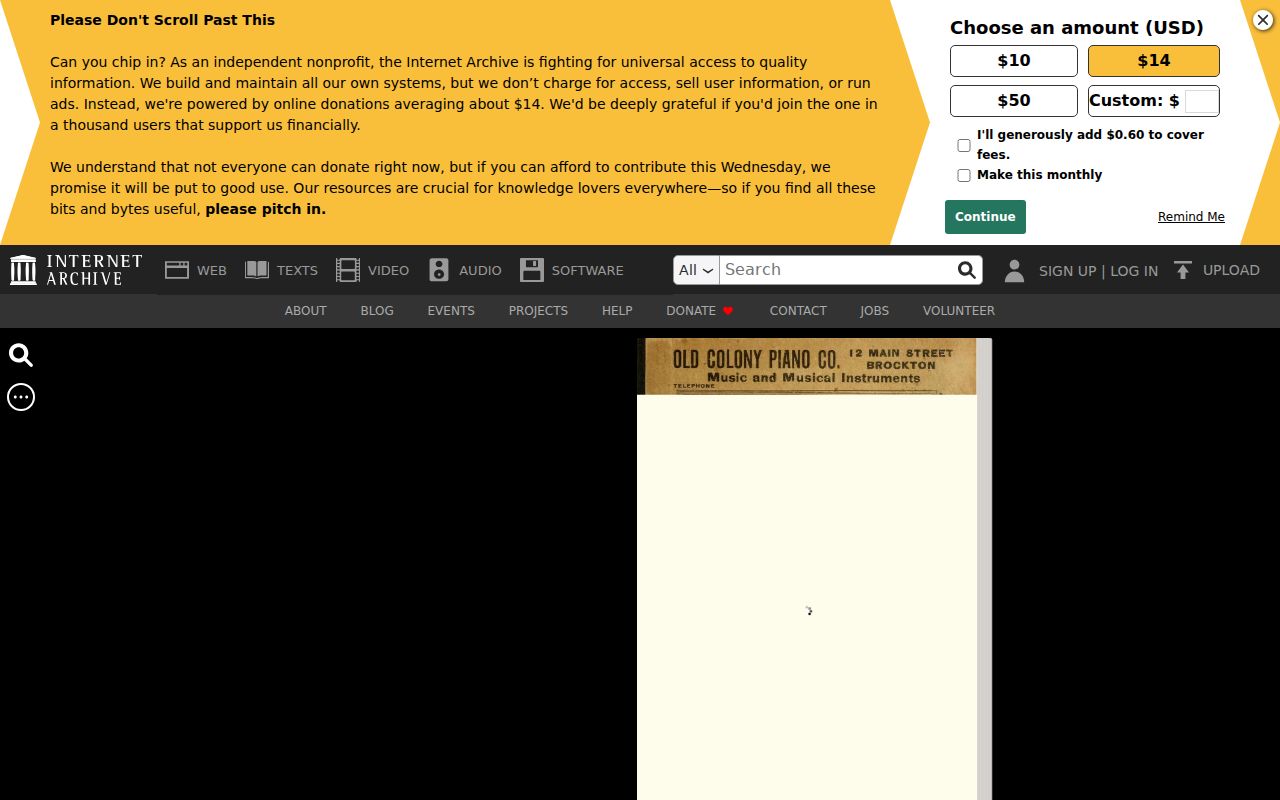
Its title and record detail help distinguish this 1909 resident and business volume from the earlier county directory and later State Library runs.
Plymouth County Directory Rooms
Plymouth Public Library keeps the non-circulating Plymouth Collection in the Bartlett Room, with duplicate history titles available in the circulating collection. The books sit in the Main Library's first-floor Reference Area. Its History Room is open by appointment through the library's online form. The reference desk lists reference@plymouth.ocln.org and 508-830-4250; the Main Library is at 132 South Street in Plymouth, with a Manomet Branch at 12 Strand Avenue.
The local collection extends well beyond historical volumes. It includes genealogies, vital-record material, town histories and reports, maps, photos, Plymouth High School yearbooks, and a subject-indexed vertical file of clippings and pamphlets. Old Colony Memorial microfilm can be read, printed, or scanned with a digital reader, while the NewsBank full-text run begins in 2009. In-library and card-based database access varies, so ask the desk which route applies before setting aside a day for a particular title.
Bartlett Room
Non-circulating Plymouth Collection, local histories, reports, maps, yearbooks, and clippings.
History Room
Public access is by appointment through the library's appointment process.
Reference Desk
Reference email: reference@plymouth.ocln.org. Main phone: 508-830-4250.
Reading Plymouth County City Directory Entries
Read the heading and abbreviation key before copying a name. The inspected 1867 pattern places surname and given name with an occupation and a street or locality. Early entries may have no house number. The 1909 resident-and-business format can also separate personal listings from firm information. Initials and work description help sort people who share a surname, but an editorial directory is not a sworn record and can contain spelling errors, lag, or an old address.
| Name | Surname first, then given name or initials. Compare occupation and locality when names repeat. |
|---|---|
| Occupation or business | A trade, profession, business classification, or firm clue that can distinguish similarly named people. |
| Address or locality | A street, house number where supplied, or a village/place name rather than a modern postal line. |
| “r” and “bds” | The 1867 material uses “r” for rents and “bds” for boards. Neither abbreviation proves legal title. |
| Widow or spouse notation | Format varies by publisher and year. Preserve it exactly, then check that volume's key. |
- Criss-cross directory
- An address or street-order section that can lead from a location to listed households when the volume includes one.
- Householder index
- An alphabetical or household-oriented finding aid that identifies the person under whom an address is listed.
- Abbreviation key
- The publisher's explanation of shortened terms, usually near the front matter. Copy it with the entry.
Business pages can name a firm, proprietor, agent, classification, and address. They are useful historical affiliation evidence, but they do not establish a current residence. Note: Treat every directory entry as a dated editorial snapshot and verify uncertain names with an independent record.
Plymouth County Directory House Histories
The Plymouth Historic Houses Collection adds a local layer that ordinary historical volumes do not provide. The Bartlett Room holds ten binders from a 1992-1995 Massachusetts Historical Commission survey, arranged by locality. An alphabetical street-name index points to specific homes. A file may name a builder, describe architecture, identify a historic house name, and record residents. That makes the collection especially useful when an old street entry needs context rather than a simple name match.
The state counterpart is MACRIS historic-inventory mapping. Use it to locate inventory points or areas, then confirm details in the underlying source. Its data can lag source files and is not a substitute for original records. The Plymouth house binders offer a direct local fallback when a modern parcel search does not explain a historic street label or a surviving building's earlier identity.
The Plymouth Antiquarian Society provides additional local house and site context through its historic properties and programs.
Its public historical context can help frame a house or neighborhood after the library binders and primary records identify the address.
Plymouth County Directories and Sanborn
The Library of Congress Plymouth Sanborn map is a March 1891 set of nine public-domain sheets. It does not list every occupant. It can, however, show a building footprint, construction material, story count, use, outbuildings, street name, and lot context. Pair that physical evidence with a directory listing, an assessor card, a deed, a newspaper notice, or a historic-house file. Together, the records can explain why a location is described differently at different dates.
This is a Plymouth-specific local quirk in the historical trail: a compact nine-sheet set can anchor the built form of a place near the 1909 directory era. It is evidence about a structure, not a roster of residents. A person should appear in a separate directory, census, deed, obituary, or probate record before being connected to the building.
Plymouth County Directory Localities
A locality name may be the missing search term. County officers material maps places such as Manomet, North Plymouth, Cedarville, White Horse Beach, Brant Rock, Greenbush, Bryantville, North Scituate, and Onset to their municipalities. An older city directory can use one of those labels instead of a current town name or postal line. Preserve the printed wording, then compare it with the county locality directory, a plan, a map, the town assessor, and USPS before translating it to a present-day address.
This geographic issue matters most near municipal and coastal edges. A listing for Green Harbor belongs in Marshfield context, while Greenbush is associated with Scituate. The location line may be more reliable than an automatic match that forces every historic record into a present ZIP. For modern property work after the historical search, use the municipality's assessor and the Plymouth County street directory route rather than relying on a nineteenth-century street notation alone.
Trace Plymouth County City Directories
Follow one household through each available year, but label the dates honestly. A directory's publication date, a census enumeration date, and a deed recording date are different facts. Start with the most likely town and surname spelling. Copy the whole entry, including occupation, street or locality, and every abbreviation. A person who disappears may have moved, died, been omitted, or fallen into a publication gap. The next volume and a second source decide which explanation fits.
- Find the likely alphabetical entry for the town and year, including initials and surname variants.
- Record the address or locality, occupation, and the volume's abbreviation meanings.
- Use a reverse or street section where the volume supplies one. Otherwise inspect the street sequence or searchable scan carefully.
- Pair directory dates with federal census releases for 1870, 1880, 1900, 1910, 1920, 1930, 1940, and 1950.
- For a disappearance, compare the old street, obituary or cemetery evidence, probate, and a later widow, heir, or estate entry.
For a current address, reverse the order. Begin with the town assessor, GIS, and land records, then work back through historical volumes, town reports, newspapers, and the Historic Houses Collection. This avoids turning a reused street number into a false household match. Note: Census, deed, and directory dates should remain separate in every family-history timeline.
Plymouth County Directory Gaps
Collection gaps are part of the evidence. The State Library record is deliberately uneven, and coverage outside Plymouth town can be multi-town, local, or absent. Plymouth Public Library offers town reports through 2015, high-school yearbooks through 2016, and Cordage News for 1945-1954. Old Colony Memorial microfilm and its post-2009 NewsBank access can supply obituaries, civic notices, school items, and property reports between printed directory years.
The Massachusetts Archives, local town clerks, and FamilySearch historical collections offer other routes where the question concerns a life event or estate. Access varies by record and some collections require an account, a reading room, or a custodian request. No official source found a countywide digital cutover or a Plymouth courthouse-loss event that would explain every missing record. The responsible conclusion is narrower: search the relevant town, date, shelf, archive, and record type before calling a gap permanent.